
Asset Depletion Mortgage Loans in Texas
Qualify for a Mortgage Using Your Assets Instead of Traditional Income
Having significant savings, retirement accounts, or investment assets does not always mean it is easy to qualify for a traditional mortgage.
Many financially strong borrowers have substantial assets but may show less monthly income than a traditional mortgage lender expects. This is especially common for retirees, investors, business owners, self-employed borrowers, and high-net-worth individuals.
An asset depletion mortgage may provide another solution.
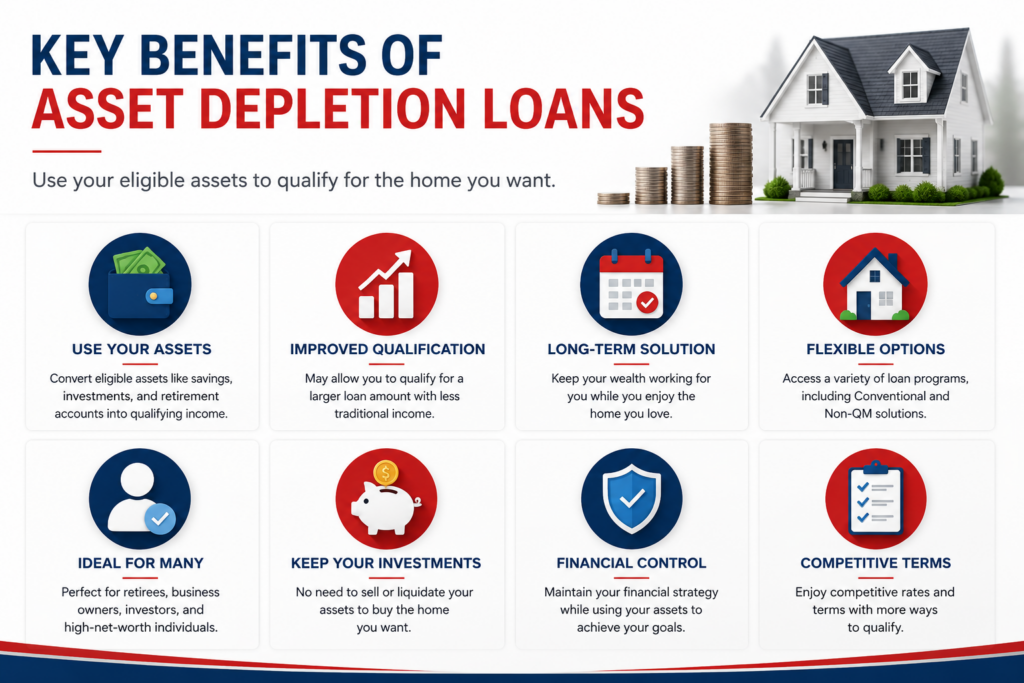
Instead of qualifying primarily from employment income, an asset depletion loan can allow eligible assets to be converted into monthly qualifying income for mortgage purposes.
Texas Premier Mortgage offers asset-based mortgage options for qualified borrowers throughout Texas. Depending on your situation, conventional and alternative Non-QM asset depletion programs may be available.
What Is an Asset Depletion Mortgage?
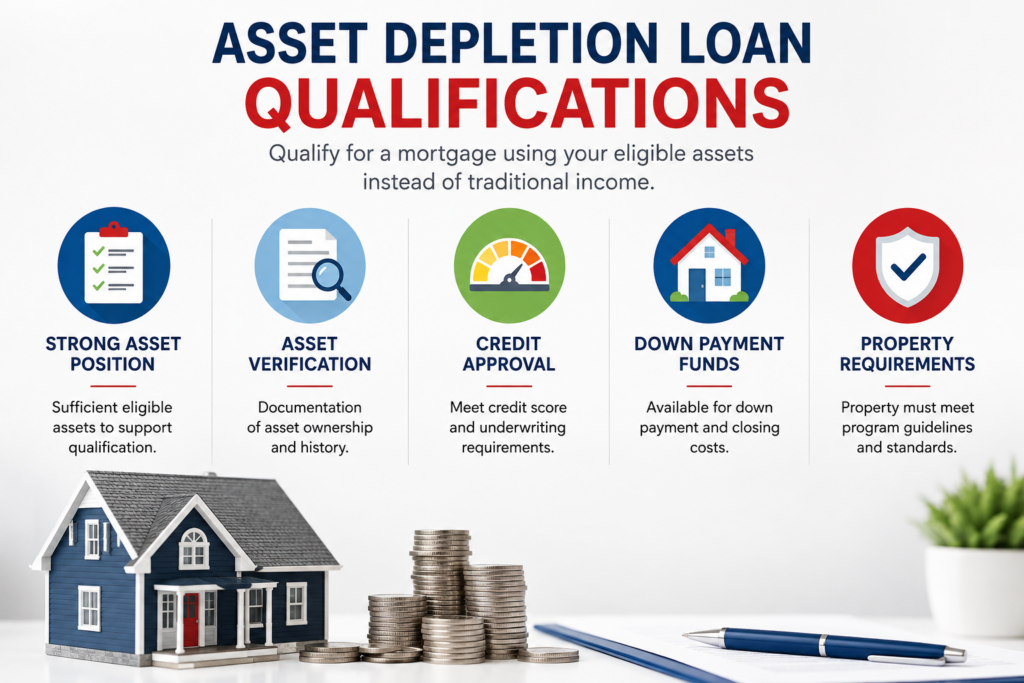
An asset depletion mortgage is a method of qualifying for a home loan using eligible assets to help establish monthly qualifying income.
The borrower does not necessarily have to sell or withdraw all of those assets. Instead, eligible assets are reviewed and a qualifying formula is used to determine how much monthly income those assets can support.
For example, someone may have substantial funds in investment and retirement accounts but only receive a modest pension, Social Security payment, salary, or other monthly income. Traditional income calculations might make that borrower appear to have limited income even though they have significant financial resources.
Asset depletion can help provide a more complete picture of the borrower's ability to repay the mortgage.
New Freddie Mac Asset-Based Mortgage Guidelines
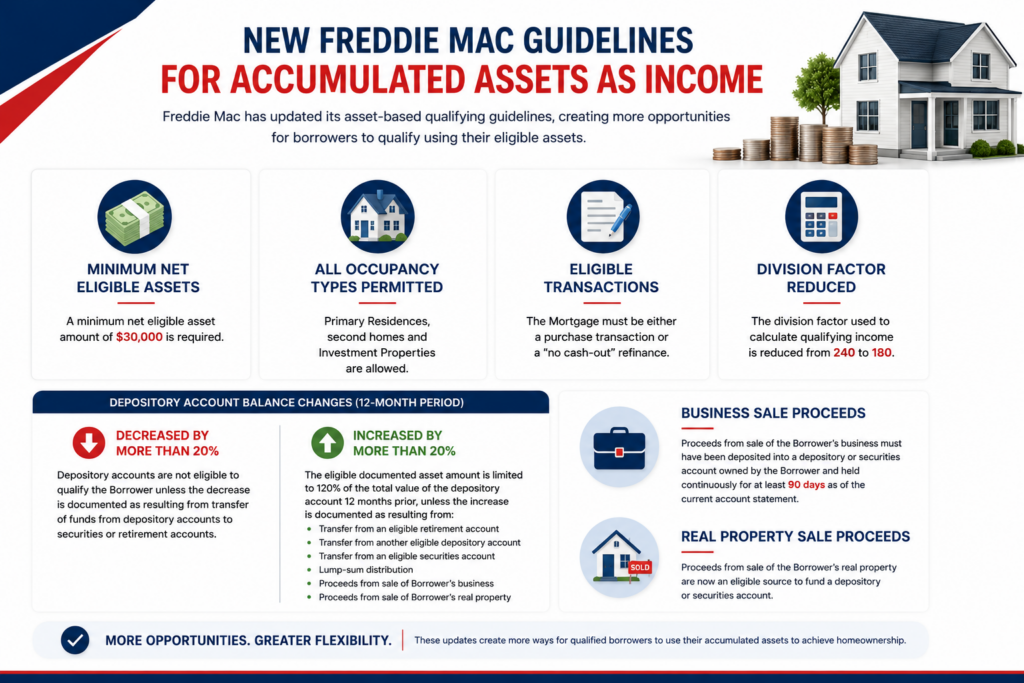
Freddie Mac has announced significant changes to its asset-based qualifying guidelines that can make this option available to more borrowers. The updated program is known as Accumulated Assets as Income. One of the most important changes is how eligible assets are converted into monthly qualifying income.
Under the updated guidelines, qualifying net assets may be divided by 180 months to establish monthly qualifying income. This is a major improvement from the previous 240-month calculation. A shorter calculation period means the same amount of eligible assets can produce more qualifying monthly income.
Simple Example
Assume a borrower has:
$1,500,000 in eligible net assets
Using a 180-month calculation:
$1,500,000 ÷ 180 = $8,333 per month
In this simplified example, approximately $8,333 per month would be considered qualifying income.
The actual calculation will depend on the type of assets, ownership, funds needed for the transaction, documentation, other debts, and the specific mortgage program.
You May Not Need a Large Salary to Qualify
This is one of the biggest advantages of an asset depletion mortgage.
A borrower could have:
- Limited employment income
- Retirement income
- Social Security income
- Pension income
- Investment income
- Self-employment income
- Part-time employment income
- Other eligible income
The asset-based income calculation may be used in addition to other qualifying income.
This can be especially helpful when a borrower has enough income to comfortably support their lifestyle but does not show enough traditional qualifying income to obtain the mortgage they want.
Who May Benefit From an Asset Depletion Loan?
Asset depletion mortgages can be particularly useful for borrowers who have accumulated substantial wealth but do not receive most of that wealth through a traditional paycheck.
Potential candidates may include:
- Retired borrowers
- High-net-worth borrowers
- Business owners
- Self-employed borrowers
- Real estate investors
- Individuals with substantial brokerage accounts
- Borrowers with significant retirement assets
- Borrowers who recently sold a business
- Borrowers who recently sold real estate
- Individuals living primarily from investments
- Borrowers transitioning into retirement
Every situation is different. Having substantial assets does not automatically mean a borrower will qualify, but it can provide another way to structure the mortgage.
What Assets Can Be Used?
Eligible assets may include certain:
- Checking accounts
- Savings accounts
- Money market accounts
- Investment accounts
- Stocks
- Bonds
- Mutual funds
- Retirement accounts - must be over 62
- IRAs - must be over 62
- 401(k) accounts - must be over 62
- Proceeds from the sale of a business
- Proceeds from the sale of eligible real estate
Not every asset receives the same treatment.
The mortgage program may consider the type of account, ownership, accessibility of the funds, length of ownership, market value, and whether any portion of the account is needed for the home purchase. Some assets may also be subject to adjustments before determining the amount available for qualifying.
What Does "Net Eligible Assets" Mean?
This is an important distinction.
A borrower cannot simply look at the total value of every account and divide that amount by 180.
The calculation generally begins by determining which assets are eligible and then accounting for funds that cannot be included in the qualifying calculation.
For example, funds being used for the transaction may need to be deducted.
Consider a simplified example:
Eligible assets: $2,000,000
Down payment and eligible transaction costs being deducted from assets: $300,000
Remaining net eligible assets: $1,700,000
$1,700,000 ÷ 180 = approximately $9,444 per month
The approximately $9,444 could then be considered as monthly qualifying income under the applicable asset-income calculation.
This is only an example. Actual calculations and eligibility are determined by the specific loan program and underwriting requirements.
Mortgage Loans for Retirees in Texas
Asset depletion can be especially valuable for retirees.
Retirement often changes the way someone's financial strength appears on a mortgage application.
A borrower may have spent decades accumulating wealth and enter retirement with substantial assets but no longer receive a traditional salary.
For example, a retiree might have:
- Social Security income
- Pension income
- IRA accounts
- 401(k) assets
- Brokerage accounts
- Savings
- Investment income
Traditional underwriting may recognize some of these income sources, while an asset-based approach can provide another way to utilize accumulated wealth when qualifying.
This can make asset depletion mortgages an important option for retirees purchasing a home in Texas.
Do You Have to Liquidate Your Investments?
Not necessarily. Asset depletion is primarily a mortgage qualification method. The calculation can use the value of eligible assets to establish qualifying income without requiring the borrower to actually withdraw the calculated monthly amount each month. This can be important for borrowers who want to obtain mortgage financing without unnecessarily liquidating a large investment portfolio to purchase a home entirely with cash. Of course, assets used for the down payment, closing costs, or other required funds would still need to be available for the transaction.
Asset Depletion vs. Paying Cash for a Home
High-net-worth buyers sometimes assume they should simply pay cash because their traditional income makes mortgage qualification difficult.
That is not always necessary.
An asset depletion mortgage may allow an eligible borrower to finance part of the purchase while maintaining a larger portion of their investment portfolio.
Whether financing or paying cash makes more sense depends on the borrower's goals, available mortgage terms, investment strategy, liquidity needs, and overall financial situation.
The important point is that having limited traditional income does not automatically mean paying cash is your only option.
Asset Depletion for High-Net-Worth Borrowers
High-net-worth borrowers can sometimes encounter an unusual mortgage problem: They have plenty of money but not enough "income."
A borrower may have accumulated significant wealth through investments, business ownership, real estate, or retirement savings while intentionally keeping taxable income relatively low. Traditional mortgage underwriting is heavily focused on documented monthly income. Asset depletion programs can provide another way to evaluate a financially strong borrower. Instead of looking only at what the borrower earns each month, qualifying assets can be included in the income calculation.
Asset Depletion for Business Owners
Business owners can also benefit from exploring asset-based mortgage options. A successful business owner may have significant personal assets while showing less taxable income because of legitimate business deductions and tax planning.
Depending on the situation, Texas Premier Mortgage may be able to evaluate several different options, including:
- Asset depletion
- Bank statement mortgages
- Profit and loss mortgages
- 1099 mortgage programs
- Conventional financing
- Other Non-QM mortgage programs
The best program is not necessarily the one with the easiest income calculation. Our goal is to determine which available mortgage structure provides the best overall combination of qualification, down payment, rate, costs, and long-term financing for the borrower.
Can Asset Depletion Be Combined With Other Income?
Yes. Asset depletion does not always have to replace every other source of income.
Eligible asset-based income may supplement other qualifying income, such as:
- Salary
- Social Security
- Pension income
- Retirement distributions
- Rental income
- Investment income
- Other acceptable income
This can be extremely helpful when a borrower is close to qualifying based on traditional income but needs additional qualifying income.
Example
Suppose a borrower has $7,000 per month in eligible traditional income.
After evaluating the borrower's eligible assets, an additional $5,000 per month can be established through asset depletion.
The borrower would have $12,000 per month of total qualifying income. This is a simplified example, but it demonstrates why asset depletion can be so valuable.
Can Younger Borrowers Use Asset Depletion?
The updated Freddie Mac guidelines can create additional opportunities for borrowers who previously may not have qualified under older asset-based rules. Historically, certain non-retirement asset categories had age-related restrictions that significantly limited the usefulness of conventional asset depletion for younger borrowers. The updated approach expands the potential usefulness of accumulated assets for qualifying. This could benefit younger high-net-worth borrowers who have accumulated significant savings or investment assets but do not have traditional income that accurately reflects their financial position. Eligibility still depends on the asset type, account history, documentation, loan structure, and automated underwriting approval.
Can Investment Accounts Be Used?
Eligible securities and investment accounts can be an important part of an asset depletion strategy. This may include certain publicly traded investments held in brokerage or securities accounts. Because investment values can fluctuate, the amount considered eligible for mortgage qualification may not always equal the account's current statement balance. The account must also meet applicable ownership, documentation, accessibility, and program requirements.
Can Retirement Accounts Be Used?
Certain retirement assets may be used, but retirement accounts have additional requirements. Access to the funds is particularly important. An account may contain substantial assets, but restrictions or penalties associated with accessing those funds can affect whether the account qualifies under a particular program. This is an area where the borrower's age and retirement-account structure can make a significant difference. Texas Premier Mortgage can review the actual accounts before determining how much of the retirement assets may be eligible.
Can Proceeds From Selling a Business Be Used?
Yes. This can create an excellent opportunity for someone who recently sold a business. A business owner may sell a company and receive substantial proceeds but no longer have the employment or self-employment income previously generated by the business. Under applicable guidelines, properly documented proceeds from the sale of a business may be considered in an asset-based qualification strategy. Additional documentation is generally required to verify the sale, ownership, proceeds, and source of the funds.
What About Proceeds From Selling Real Estate?
The updated Freddie Mac framework also creates opportunities involving eligible proceeds from the sale of real property. This can be helpful for borrowers who have recently sold a property and now have substantial liquid assets available. The history of ownership, documentation of the sale, location of the proceeds, and length of time the funds have been held may all be important. Rather than assuming the money can or cannot be used, we can review how the funds were obtained and determine the available mortgage options.
Conventional Asset-Based Mortgage
A conventional option may be attractive when the borrower can meet the applicable Freddie Mac or other conventional underwriting requirements. Potential benefits can include conventional mortgage pricing and terms. However, conventional guidelines can be more restrictive regarding which assets qualify and how the qualifying income is calculated.
Do Asset Depletion Loans Require Tax Returns?
It depends on the program and the other income being used to qualify. Some asset-based and Non-QM mortgage programs may offer qualification methods that do not rely primarily on personal tax returns. Conventional mortgage requirements can be different. If avoiding traditional tax-return qualification is important, let us know at the beginning of the process so we can evaluate the appropriate programs.
How Much in Assets Do I Need?
There is no single asset balance that works for every borrower.
The amount needed depends on several factors, including:
- Home price
- Loan amount
- Down payment
- Closing costs
- Existing monthly debts
- Property taxes
- Homeowners insurance
- HOA dues
- Other qualifying income
- Type of assets
- Mortgage program
- Interest rate
A borrower seeking a relatively small mortgage with significant assets may have a very different qualification result from someone trying to finance a much larger percentage of the property's value.
The easiest way to determine whether asset depletion will work is to review the actual numbers.
Documentation for an Asset Depletion Mortgage
Documentation varies by program, but borrowers should generally be prepared to document the assets being used for qualification.
This could include:
- Bank statements
- Brokerage statements
- Retirement account statements
- Evidence of account ownership
- Documentation showing access to funds
- Documentation of large deposits or transfers
- Real estate sale documentation
- Business sale documentation
- Other documents depending on the source of the assets
The objective is to establish that the assets exist, belong to the borrower, are eligible under the program, and can appropriately be used in the qualifying calculation.
Why Work With Texas Premier Mortgage?
Asset-based lending is not a one-size-fits-all mortgage program. A borrower who does not qualify under one asset depletion calculation may qualify under another mortgage program. As a Texas mortgage broker, Texas Premier Mortgage can evaluate multiple lending options and determine which available program is appropriate for the borrower's situation. We work with borrowers throughout Texas, including retirees, investors, self-employed borrowers, business owners, and high-net-worth individuals whose finances may not fit traditional mortgage guidelines.
Instead of assuming that a borrower with limited traditional income cannot qualify, we look at the complete financial picture.
Frequently Asked Questions About Asset Depletion Mortgage Loans in Texas
What is an asset depletion mortgage?
An asset depletion mortgage allows eligible assets to be converted into monthly qualifying income for mortgage qualification purposes. It can help borrowers who have substantial assets but limited traditional employment income.
Is an asset depletion mortgage only for retirees?
No. Retirees can benefit from asset depletion, but these programs may also be available to high-net-worth borrowers, investors, business owners, self-employed borrowers, and other borrowers with significant eligible assets.
Can I qualify for a mortgage using my investments?
Yes. Eligible investment and securities accounts may be considered depending on the mortgage program, ownership, accessibility, documentation, and other underwriting requirements.
Do I have to sell my stocks to qualify?
Not necessarily. Using an investment account for asset-based qualification does not automatically mean the entire account must be liquidated. Funds actually needed for the transaction must still be available.
Can I use my 401(k) for an asset depletion mortgage?
Certain retirement accounts may be eligible if they satisfy the applicable mortgage guidelines. Access to the funds and potential withdrawal restrictions are important considerations.
Can an IRA be used to qualify for a mortgage?
Yes. Eligible IRA assets may be considered depending on the borrower's circumstances and the mortgage program.
Can I get a mortgage after I retire?
Yes. Retirement does not prevent someone from obtaining a mortgage. Social Security, pension income, retirement distributions, investment income, and eligible assets may all be considered when determining qualification.
Can I qualify for a mortgage without a job if I have substantial assets?
Yes. Employment is not the only way to demonstrate the ability to repay a mortgage. Depending on the loan program, eligible assets and other income sources may be used for qualification.
How does Freddie Mac calculate asset income?
Under Freddie Mac's updated accumulated-assets framework, eligible net assets may be divided by 180 months to determine a monthly qualifying income amount. The actual calculation depends on which assets are eligible and what amounts must first be deducted.
Can asset depletion income be combined with Social Security?
Yes. Eligible Social Security income and asset-based qualifying income may both be considered if all applicable requirements are satisfied.
Can asset depletion be combined with pension income?
Yes. Asset-based income may supplement eligible pension or other retirement income.
Can I use money from selling my business?
Eligible and properly documented proceeds from the sale of a business may be considered under applicable asset-based mortgage guidelines.
Can I use proceeds from selling another property?
Yes. Under the updated Freddie Mac framework, qualifying proceeds from the sale of real property may create additional opportunities, subject to applicable ownership, seasoning, documentation, and underwriting requirements.
Are asset depletion mortgages conventional loans?
Yes. Certain conventional mortgages allow assets to be used for qualifying. There are also Non-QM asset depletion programs that may offer different or more flexible guidelines.
Are asset depletion mortgage rates higher?
No. The rate depends on whether the loan is conventional or Non-QM, along with credit score, loan-to-value, property type, loan amount, market conditions, and other factors.
Are asset depletion loans available throughout Texas?
Yes. Texas Premier Mortgage can evaluate asset depletion and asset-based mortgage options for qualified borrowers throughout Texas.
What credit score is required for an asset depletion mortgage?
Credit requirements vary by program. Asset depletion changes how income may be calculated; it does not eliminate the other credit and underwriting requirements associated with the mortgage.
Is asset depletion the same as a bank statement loan?
No. A bank statement mortgage generally analyzes deposits or cash flow to establish qualifying income, while an asset depletion mortgage uses eligible accumulated assets to establish qualifying income.
Is asset depletion the same as a DSCR loan?
No. A DSCR loan generally qualifies an investment property primarily using the property's rental income and expenses rather than the borrower's personal income. Asset depletion uses the borrower's eligible assets as part of the qualification.
How do I know if an asset depletion mortgage will work for me?
The best way is to have your actual financial situation reviewed. The amount and type of assets, loan amount, property, down payment, debts, credit profile, and other income can all affect which program works best.

Find Out If Your Assets Can Help You Qualify
If you have substantial assets but have been told you do not show enough traditional income to qualify for the mortgage you want, there may be another option.
Texas Premier Mortgage can review your savings, investment accounts, retirement assets, income, and overall financial situation to determine whether an asset depletion mortgage, conventional loan, or alternative Non-QM program may work.
We serve borrowers throughout Texas and specialize in finding mortgage solutions for borrowers whose finances do not always fit traditional lending guidelines.
Contact Texas Premier Mortgage today to discuss your asset depletion mortgage options in Texas or complete the “quick quote” form.


